
Teaching Star Names
With kind permission herewith we share a letter from two Italian primary school teachers:
Dear friends at WGSN
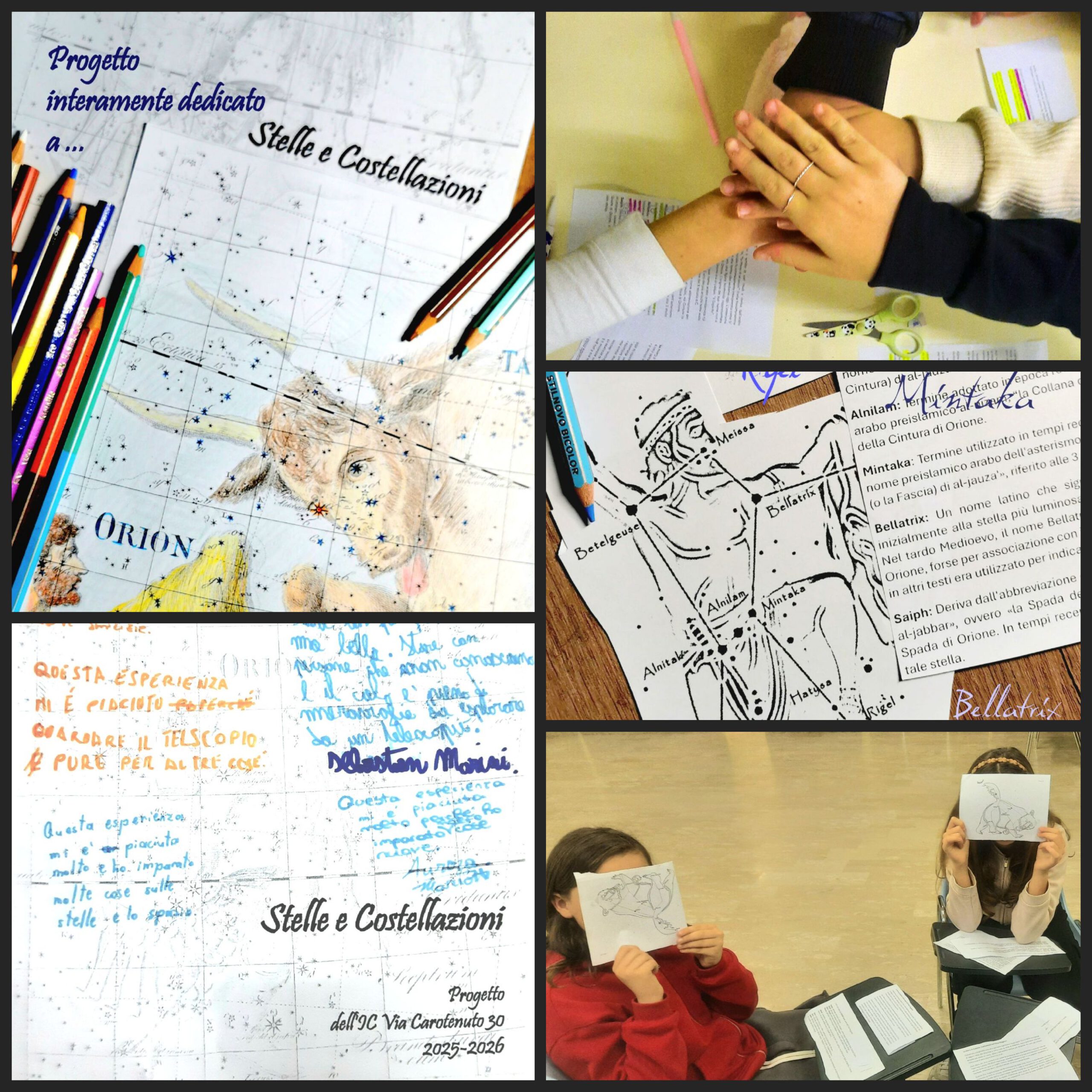
I am pleased to inform you that over the past few weeks, with the help of a colleague of mine, I have carried out for a group of about twenty elementary school students from the I.C. Via Carotenuto 30 in Rome, a project entirely dedicated to the names of stars, the identification of constellations, the study of the mythological stories in which they feature, and the etymology of the names of their brightest stars.
Unfortunately, the sky over our city allows us to see only the brightest stars in the night sky, and that is a real shame, because for the young students it was truly exciting to be able to connect those dots and recognize those shapes and characters born from the imagination of ancient peoples, to listen to their mythological stories, and to be able to recognize and name dozens of stars, such as Betelgeuse, Sirius, Mirzam from the winter constellations, and Arcturus, Mizar, Nekkar, and Seginus from the spring constellations, and finally being able to describe the meaning of these terms.
Starting with easily identifiable asterisms, such as Orion’s Belt and the Big Dipper, we gradually moved on first to the other stars that make up Orion and the Big Dipper, and then to those of the neighboring constellations. We thus learned to orient ourselves, to recognize their faint colors, to understand why they twinkle, and to realize that behind the appearance of those tiny dots lie enormous spheres of extremely hot gas, just like the Sun.
When it was cloudy, our virtual night sky was the Stellarium software; but when the sky was clear, the ceiling of our classroom became the real sky, and in addition to observing with the naked eye, we also viewed some stars through a telescope to discover their binary nature and to better see their color.
Our sources for these studies was the IAU CSN and the website exopla.net; that is why I am here to tell you all this and to thank you once again—also on their behalf—for your great work, which allows all of us to name and evoke the stars of the night sky with both knowledge and poetry. Thanks!
Best regards
Paolo Palma and Tiziana Gentili
“Io penso che la notte sia più viva e più riccamente colorata del giorno”
Vincent van Gogh
5 Responses
Of course, what a splendid website and illuminating posts, I surely will bookmark your site.All the Best!
Everything is very open and very clear explanation of issues. was truly information. Your website is very useful. Thanks for sharing.
I have recently started a web site, the information you provide on this web site has helped me greatly. Thanks for all of your time & work.
You actually make it appear so easy together with your presentation however I in finding this topic to be actually one thing which I feel I might never understand. It sort of feels too complicated and extremely extensive for me. I’m taking a look ahead on your next submit, I’ll attempt to get the cling of it!
Normally I don’t learn article on blogs, but I wish to say that this write-up very forced me to check out and do so! Your writing style has been surprised me. Thanks, quite great post.
Comments are closed.