
How Stars get Names
Our workflow is sophisticated, as it has developed over time. The basic concept is that pro bono work in the IAU has to rely on published research; WGSN collects the results of published research in the “All Skies Encyclopaedia” (ASE) and uses terms for global nomenclature only if they are well documented in the ASE. The judgement about what is “well-documented” is made by a “neutral committee” after a group decision in which all members may express their opinions, objections, and concerns.
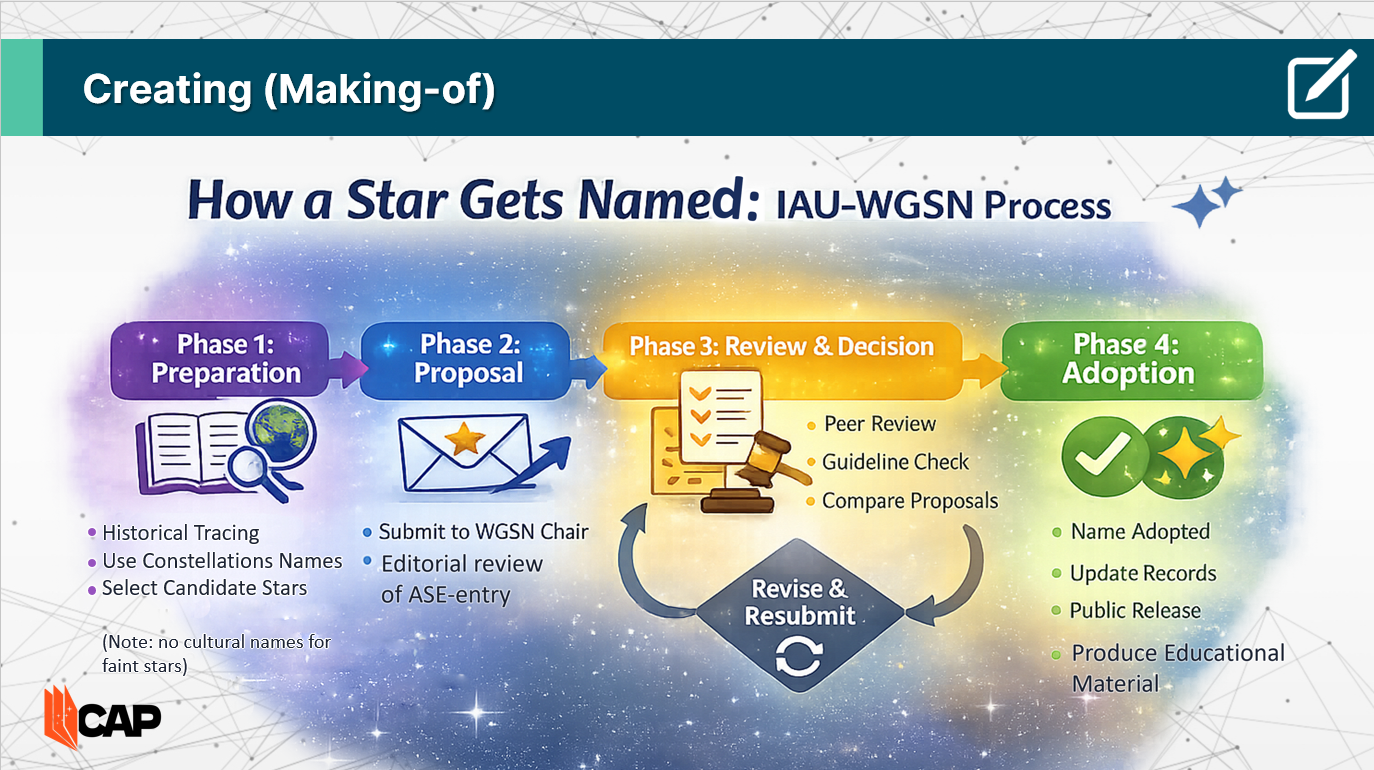
Naming Stars (WGSN 2026)
as presented at the CAP conference 2026 (CC BY Sadegh Faghanpour)

Naming Stars (WGSN 2026)
Researchers prepare ASE entries; they are reviewed by non-peers to ensure public, inter- and transdisciplinary understandability, and completeness of information with regard to the required categories.
Name suggestions for stars are negotiated in WGSN meetings and adopted subsequently in the WGSN-Neutral Committee.
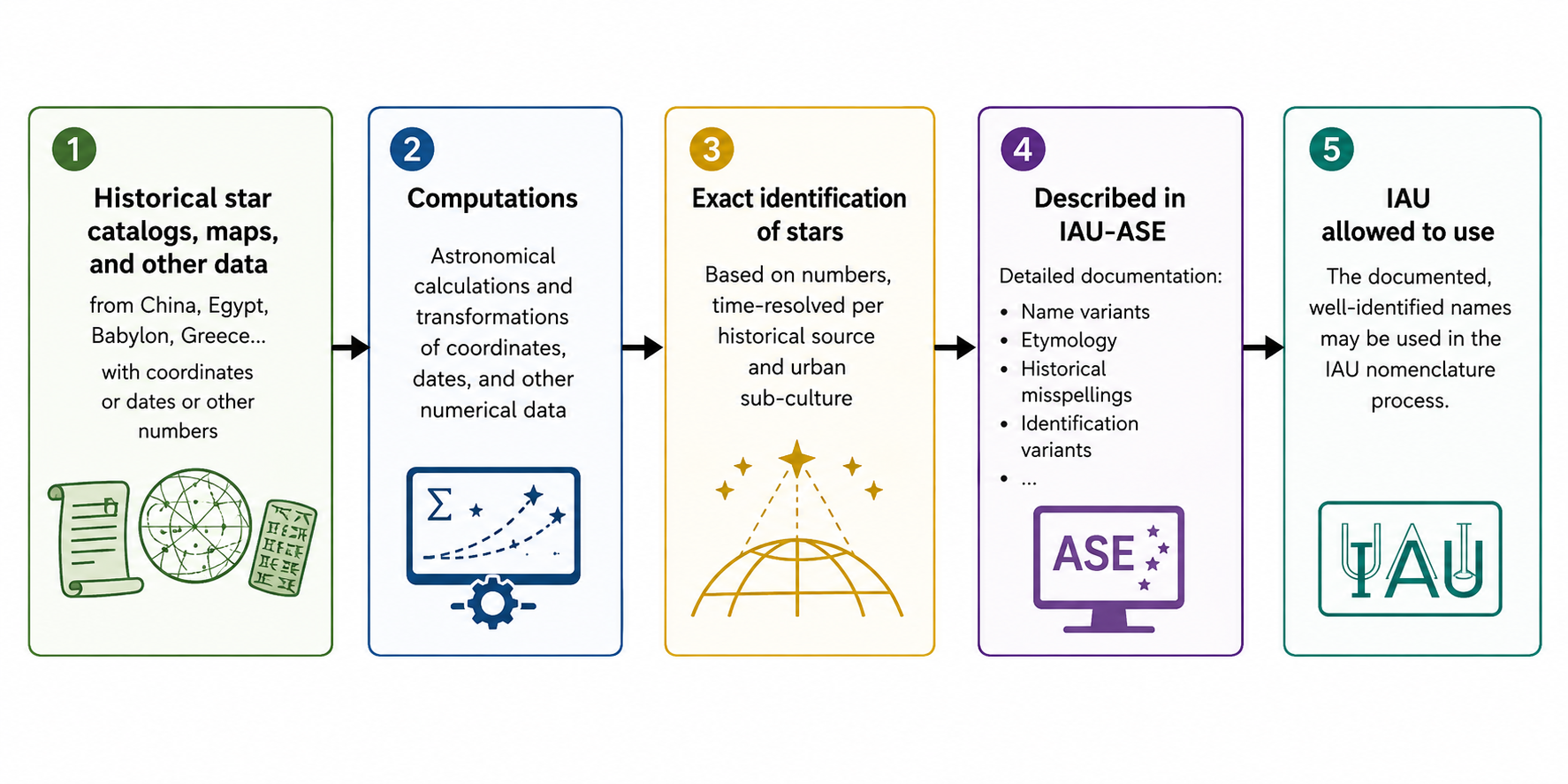
Procedure for Historical Names
Historical data is interpreted by computations and text analysis. The results of published research is summarised and referred to in the ASE, which is the base for nomenclature work.
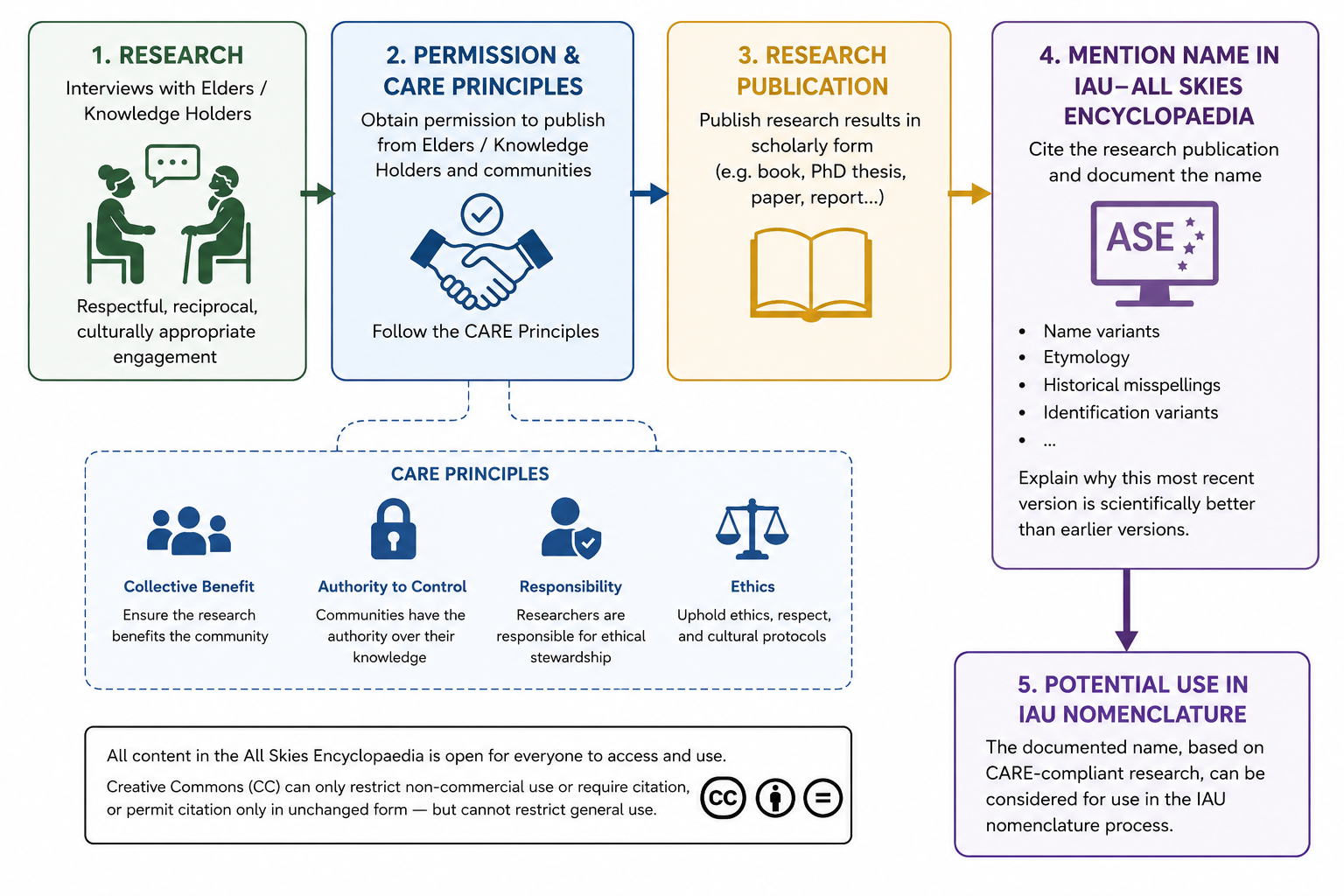
Procedure: Names of Living Cultures
Research on living cultures is often based on interviews and leaves room for different practices in subcultures. CARE considerations need to be included before publication. WGSN relies on high-quality research that respects these principles.
Historical Development
The Working Group on Star Names was established after the IAU-GA 2015. After some initial attempts to get it started, with new tasks and more members, the workflow and structure has been developed:
1
Original Declaration (2016)
Setting first standards, approving spelling
(mode below)
2
Terms of Reference (2021-2024)
Developing Resources & Technologies
(more below)
3
Workflow (since 2024/’25)
(see above)
EXOPLA.NET
WGSN Workbench
WGSN Tools
All Stars Encyclopaedia (ASE)
Our Repository for Documentations with references to the original research publications.
Terms of Reference (Triennial Report 2021-2024)
The following Terms of Reference for the IAU functional Working Group Star Names was approved by Division C to guide its activities during the past triennium:
”The Working Group on Star Names (WGSN) consists of an international group of astronomers with expertise in stellar astronomy, astronomical history, and cultural astronomy who research and catalog proper names for stars for the use by the international astronomical community and also to aid the recognition and preservation of intangible astronomical heritage.
WGSN maintains the IAU Catalog of Star Names. The focus during the 2021-2024 triennium will be:
Ongoing Mission
* to continue an exhaustive search of star names from the cultural astronomy literature,
* to adopt new IAU proper names for stars of scientific and historical value for community use following WGSN guidelines,
* to provide relevant expertise to support other IAU efforts related to celestial nomenclature, including public naming campaigns (e.g. NameExoWorlds).
Anticipated Outputs
* to maintain the IAU Catalog of Star Names‡ and assist the IAU with maintaining its web content on celestial nomenclature,
* to add etymological information to the IAU Catalog of Star Names in the interests of further preserving astronomical heritage,
* to construct a new supporting list or name bank of names for stars and associated asterisms which is culturally and geographically diverse,
* to refine WGSN guidelines for the proposal and adoption of names for stars.
Following the past triennium, the naming purview for the WGSN will continue to be for stars, substellar objects, and stellar remnants, but specifically exclude exoplanets (purview of the new EC WG Exoplanetary System Nomenclature), interstellar medium features (nebulae), and extragalactic
objects. Cultural names of asterisms have been added to the research purview of the WGSN in the interests of facilitating etymological investigations among Div C members (many traditions name a great number of asterisms and relatively few bright stars). In some cases, ancient asterism names may provide a potential source of new IAU names for individual stars. WGSN will also deliberate on the process by which “new” names for stars and substellar objects of scientific significance can be proposed by members of the international astronomical community.
The activities of the Division C WG Star Names are well-aligned with the IAU Strategic Plan 2020-2030 and the activities of IAU Division C, and the Working Group is considered Functional. The WGSN is specifically called out on p. 22 of IAU Strategic Plan 2020-2030:
”The IAU serves as the internationally recognised authority for assigning designations to celestial bodies and their surface features. To do so, the IAU has a number of Working Groups on various topics, most notably on the nomenclature of small bodies in the Solar System and planetary systems under Division F and on Star Names under Division C.“

The first triennium will focus on incorporating “past” names (from astronomical history and culture) into modern usage, and it is anticipated that in future triennia the WGSN would act as the IAU WG responsible for defining the rules and enabling the process by which new names for stars and substellar objects of scientific significance can be proposed by members of the international astronomical community.
The naming purview for the WGSN will specifically be for stars, substellar objects, and stellar remnants, and specifically excludes exoplanets (purview of EC WG Public Naming of Planets and the Planetary Systems), interstellar medium features (nebulae), and extragalactic objects. Exoplanet names will be catalogued as well so as to avoid duplication with star names.
Initial Declaration
The following is an abbreviated summary of the terms of reference for the Division C IAU Working Group on Star Names approved by the IAU Executive Committee at the EC98 meeting 6 May 2016 for period 2016-2018.
The Working Group on Star Names (WGSN) will consist of an international group of astronomers with expertise in stellar astronomy, astronomical history, and cultural astronomy. The group will catalog and standardize proper names for stars for the international astronomical community. Names will first be drawn upon the extensive historical and world-wide cultural astronomy literature. The WGSN will:
* establish IAU guidelines for the proposal and adoption of names for stars,
* carry out an exhaustive search of the international astronomical history and astronomical culture literature for candidate star names,
* drawing upon the historical and cultural literature, adopt new unique names for stars of scientific and historical value for community use following agreed upon guidelines,
* assemble, maintain, publish, and disseminate an official IAU star name catalog (“IAU-SNC”) of names for stars and exoplanets (including updating the information about the naming of stars on iau.org and posting the IAU-SNC on iau.org),
IAU-Style Manual (1989)
WGSN follows The IAU Style Manual (Wilkins 1989)
6.11 Languages used by the IAU are English and French; American or British spelling and syntax may be used.
6.12 Accents and diacritical marks should be given whenever this is customary, but are usually omitted from capital letters.
5.25 The Bayer designations of bright stars should be printed in upright type with lower-case Greek letters followed by the standard three-letter abbreviations for the names of the constellations that are given in [their] Table 11. If Greek type is not available, the English name of the Greek letter should be spelt out in full. The English names for the letters of the Greek alphabet are given in [their] section 6.32. General rules for the designation of astronomical objects are given in [their] section 7.
7.11 Nomenclature should be clear and unambiguous.
7.12 The Dictionaries [now: databases] of the Nomenclature should be consulted before new designations are introduced.
7.13 Authors should not introduce new designations for objects for which satisfactory designations already exist.