Responsibility
The International Astronomical Union (IAU) is charged with the responsibility of adopting names for celestial objects, like solar system objects, stars and exoplanets by international agreement. The IAU Working Group on Star Names (WGSN) is the body assigned to issues related to the nomenclature of proper names of stars. For this purpose, WGSN maintains the IAU-Catalog of Star Names (CSN) as an online document providing basic information about the stars and short etymologies of the named stars.
Names adopted by the IAU must follow various conventions established and amended through the years by the Union. Nomenclature is a tool and the first consideration should be to make it simple, clear, and unambiguous. Hence, there will be exactly one name per star in the IAU-CSN.
The IAU saw the need for formalizing names and spellings of some stars in the era of exoplanet discoveries after the IAU elected to adopt proper names for exoplanets and their host stars through public naming campaigns. This necessitated a through search of historical and cultural astronomy literature via the formation of the IAU Working Group Star Names. New names for exoplanets and their host stars are under the purview of the IAU WG Exoplanetary System Nomenclature, and have been adopted through the NameExoWorlds Public Naming campaigns. Alphanumeric designations for stars (i.e. those that include an acronym followed by an index number and/or celestial position) are under the purview of IAU Commission B2 Designations and Nomenclature. Names do not replace the designations.
However, there are cultural names for stars all over the planet: many cultures have projected their cultural heritage into the sky. In general, we recognise names of stars and constellations (asterisms) already in use in some culture at some point in time around the world.
The IAU respects all cultures and, thus, aims for diversity among star names. Names from underrepresented cultures (in terms of their international visibility) are appreciated. WGSN currently defines a procedure and develops tools for suggesting these names (see separate page).
IAU-star name may be used internationally along with, or instead of, the scientific designation, permanently and without restrictions.
this section of the guidelines will be detailed and updated in 2026
Visibility Rule
Formal Rules
Political Rules
Political Rules
(similar to other IAU Nomenclature)
Names of pet animals are excluded.
Personal names of living or dead human individuals are prohibited.
Names of commercial, political or military significance are not permitted
Names must be non-offensive.
Names of individuals, places, activities or events principally known for religious activities are not permitted.
.
Careful with Generic Terms
Generic words, such as “university” (English) or “daxue” (transliterated Chinese), are strongly discouraged in names. Use contractions wherever possible, such as “uni”.
Acronyms Discouraged
Names that are acronyms are discouraged. Any such names must be pronounceable and unique. As an alternative, creative variations written as a normal word are encouraged. Creative variations are required if the acronym can only be pronounced by spelling out the letters.
Visibility Rules
Keeping Heritage – not Hiding it in Invisibility
.
brighter than V = 6.5 magnitude
Bright or naked eye stars
may have IAU names adopted by WGSN from cultural names (e.g. historical, Indigenous…) for either the star itself, an asterism of which the star is a part or in the vicinity, or alternative names associated with the constellation or asterisms to which the star belongs.
For that purpose, WGSN created the Naked Eye star Catalog (NEC).
With cultural names, WGSN names “visible dots”. In known multiple star system the name is applied to the primary star and components would usually append “A” or “B” (e.g. “Sirius” with the components “Sirius A”, “Sirius B”).
In case of two-word-names for the “visible” dot, this could be considered as compound word of names of the two components (e.g. “Lang-Exster” for α Tuc where Lang and Exster can be applied to the two (unresolved) components).
fainter than V = 6.5 mag
Faints Stars
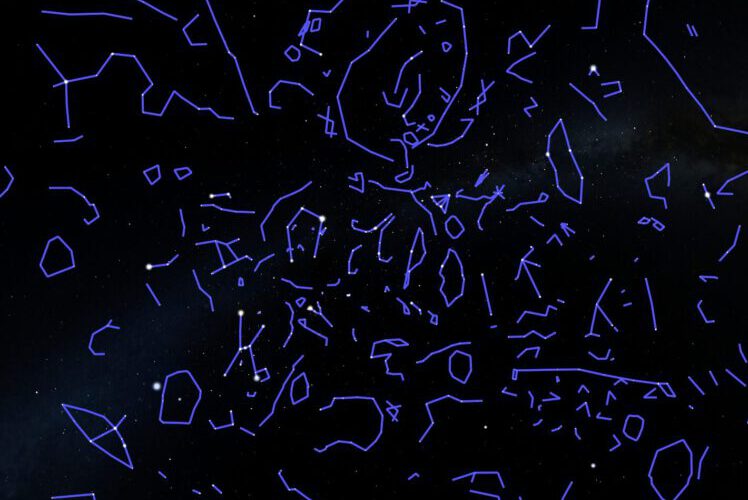
Stars fainter than 6.5 mag can bear cultural or invented names from NameExoWorlds Campaigns (NEWCs) or other suggestions.
Discoveries
Science
Newly discovered objects, e.g. host stars of exoplanets and invisible companions of known stars get designations
After an object has been confirmed and accepted for at least five years, its discoverers may submit a single, well-substantiated naming proposal prior to any public naming campaign.
Proposals must demonstrate clear scientific, historical, and cultural merit, comply fully with the formal criteria below, and reflect rigorous scholarly judgment. Submissions that do not meet this standard will not be considered.
Formal Rules
Names become officially adopted by the IAU when they are published by the WGSN in the IAU-CSN (see this page).
Script
Names must be in the modern Latin script and must have an initial capitalized letter.
No Numbers
Names cannot contain numbers. This includes numbers as digits (e.g., “4”), as words (“four”) or as Roman numerals (“IV” or “iv”).
Minimum Length
Names should preferably be at least 4 characters in length.
Variances may be granted for short names demonstrated to be in common historical use, if the term does not cause confusion (e.g. with existing abbreviations, units of measure etc.).
See concatenation rules.
Technical Rules
Names are limited to a maximum length of 16 characters (technically given).
Names as proposed must not contain any diacritical marks and other extensions to the Latin script that are present in the source name. (However, the original script and complete Romanisation with diacritics will be given in our etymology table and encyclopaedia.)
No Duplicates
Names must not match the existing name of any other astronomical object with standardised IAU-name, e.g. satellite of a major or minor planet, an IAU-constellation, a minor planet, or an exoplanet.
Names must differ from any similar name by at least one letter.
Concatenation rules
It is allowed and encouraged to merge two words into one, to connect them with a hyphen. Spellings with space in between (two words) are discouraged; if necessary, a word must have at least three characters.
Severability
Existing names that are in violation of these rules and guidelines will not be changed. Historical names that violate these guidelines may not be corrected in the interest of continuity in nomenclature and not generating unnecessary confusion.
These Rules and Guidelines will be updated, as necessary, if it is found to be lacking. Updates will be proposed by WG members (perhaps based on feedback from discoverers) and will require a majority vote by WG members for approval.