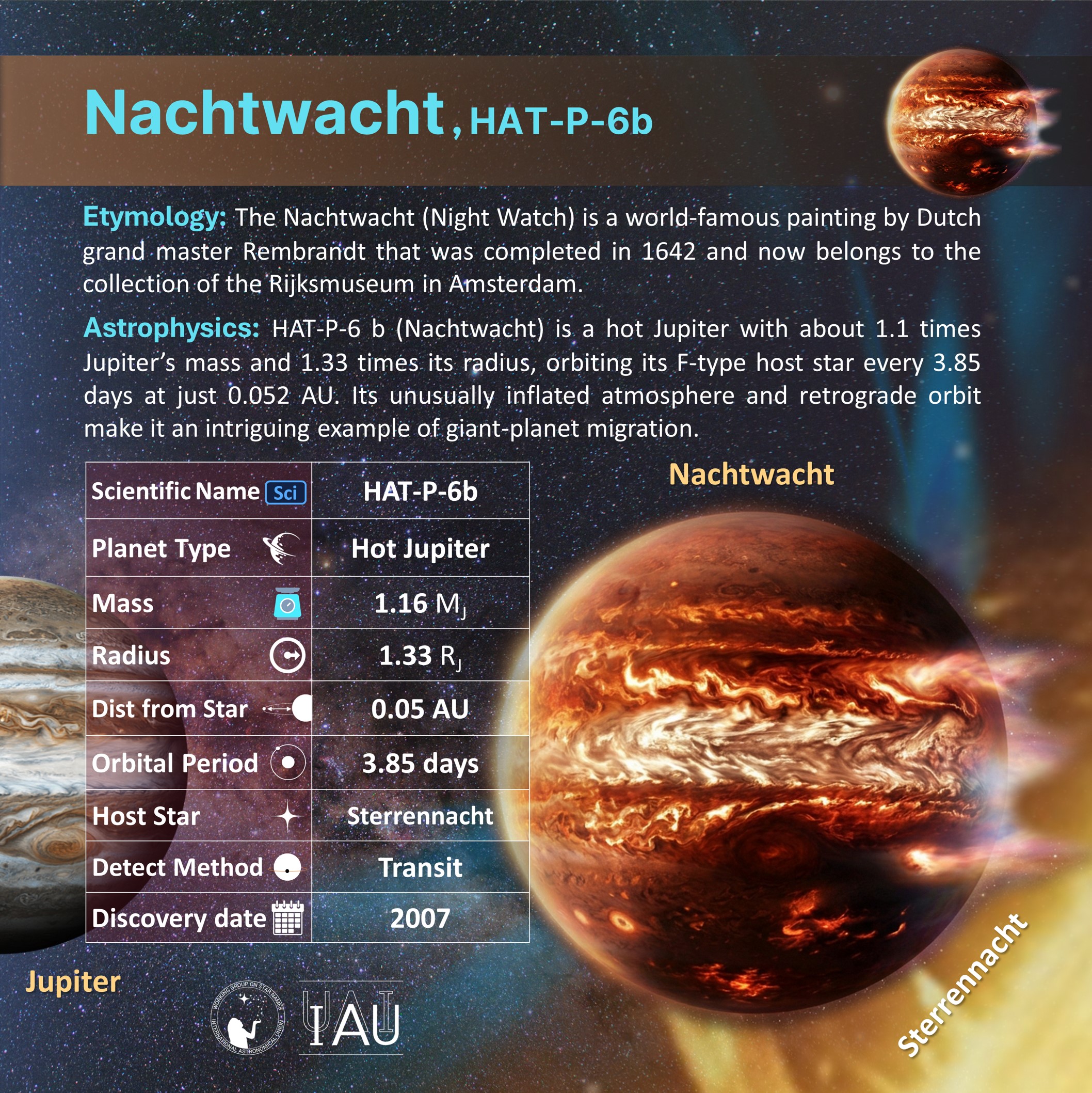
Sterrennacht
Vincent van Gogh’s famous painting “Starry Night” is currently making headlines because, in a new study, some researchers claim to have identified the stars in the painting (see myprevious post).
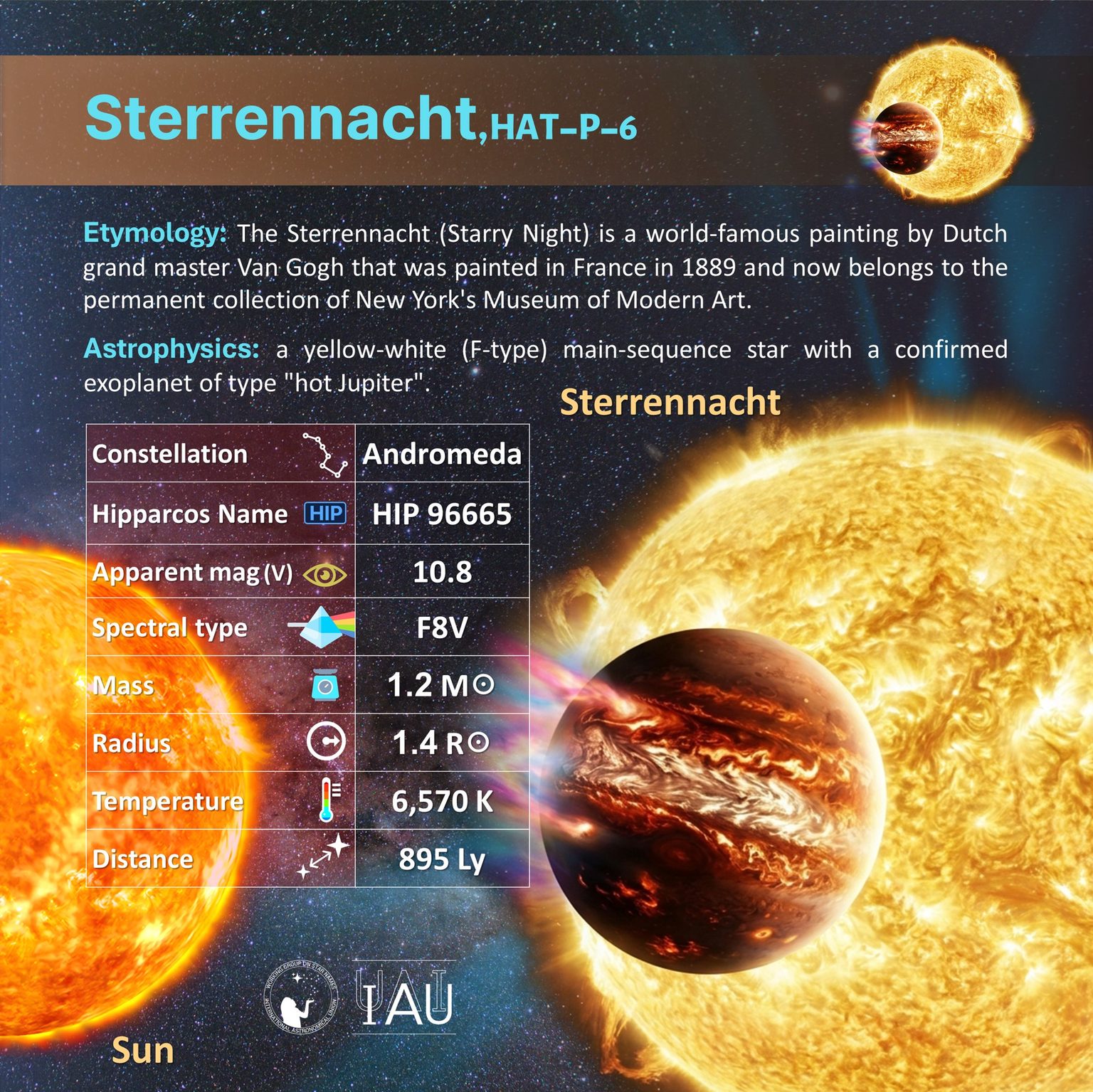
What is less well known is that the IAU also named a star after this painting. In 2019, the IAU celebrated its 100th anniversary and therefore launched a particularly large-scale naming campaign (text from their website):
“As part of its international (UN-recognized) mission to promote and preserve astronomy through international cooperation, the IAU is the authority responsible for assigning official names to celestial bodies. To mark its 100th anniversary in support of international cooperation (IAU100), the IAU now wishes to contribute a significant symbol of global brotherhood among all people. Following the first “NameExoWorlds” contest, in which nineteen “ExoWorlds” (star plus planets) were named in 2015, the IAU’s “NameExoWorlds” project offered every country the opportunity in 2019 to name a planetary system consisting of an exoplanet and its host star. The star assigned to a country is visible from that country and bright enough to be observed with small telescopes.”
This campaign was carried out by the Office for Astronomy Outreach in collaboration with the Working Group on Star Names.
IAU Star Name (CSN)
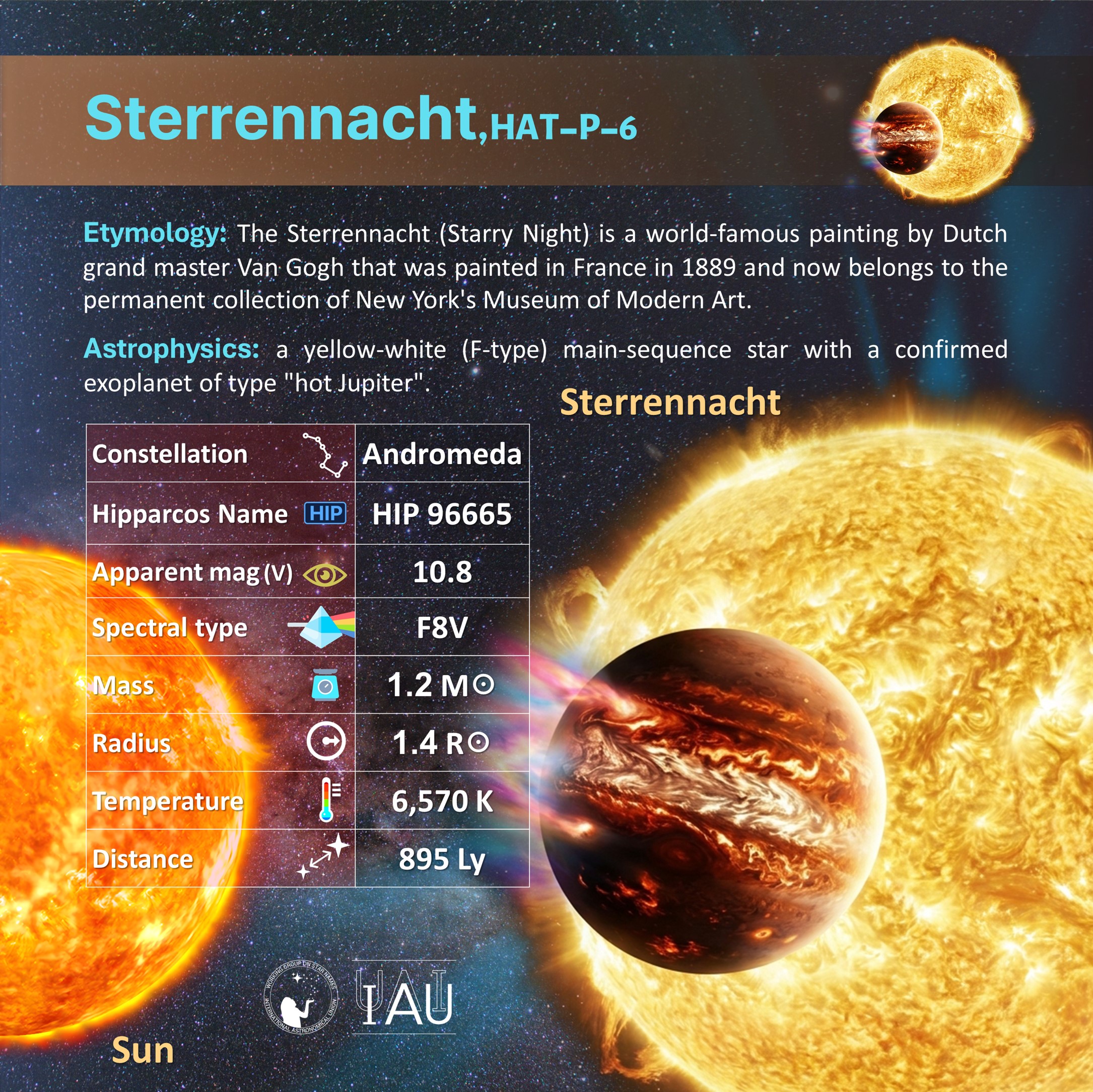
The IAU’s Catalog of Star Names (CSN) therefore includes the name “Sterrennacht,” which was proposed by the Netherlands.
IAU Catalog of Exoplanet Names (CEN)
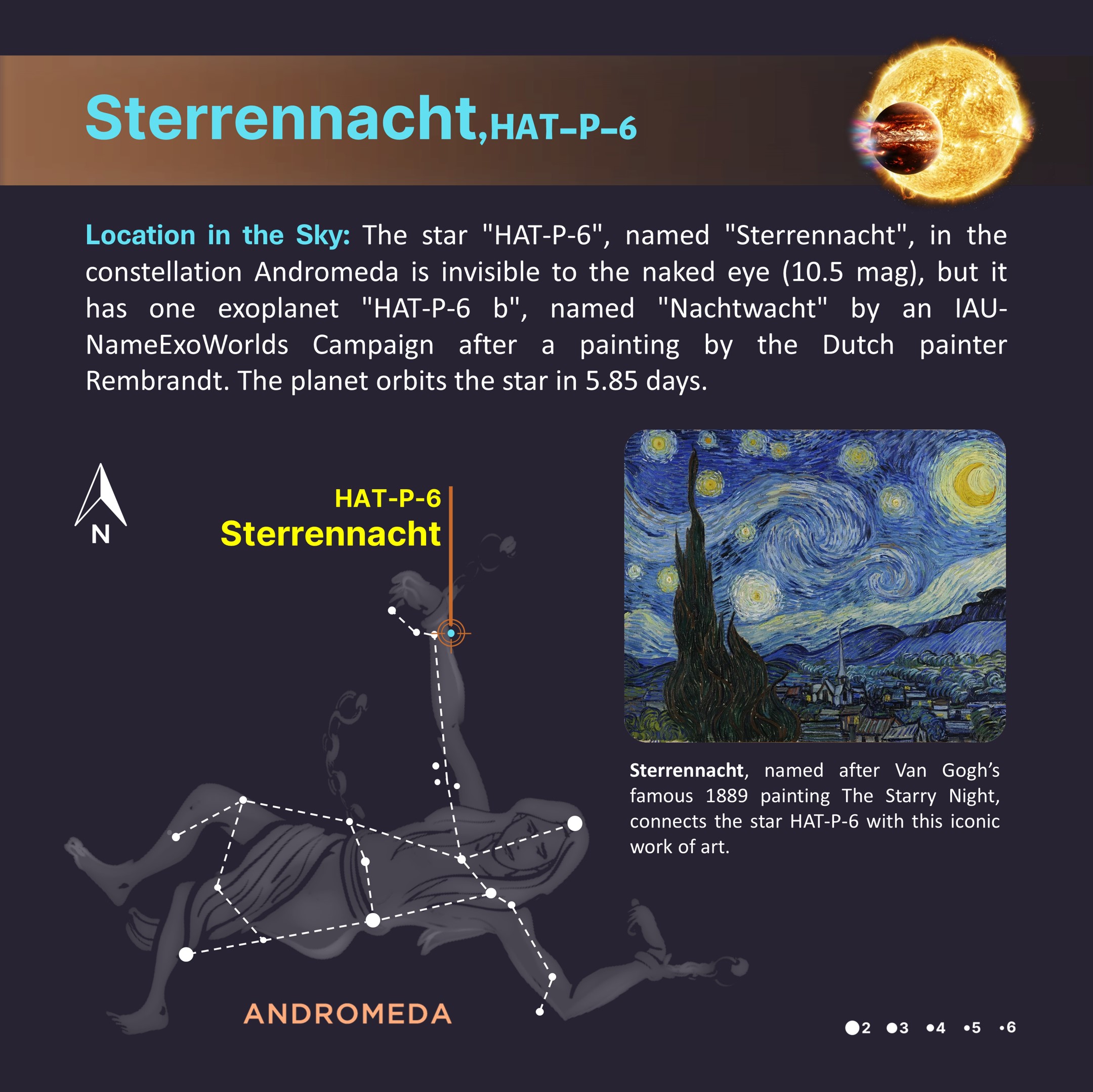
The planet in “Sterrennacht” is a “hot Jupiter” and was named “Nachtwacht,” which is also the title of a painting by the Dutch master Rembrandt. The IAU maintains the Catalog of Exoplanet Names (CEN) for planet names.
Current Headlines (new study)
A new study was recently published in “Scientific Reports,” a journal published by Nature: it is claimed that in the painting “Sterrennacht” (Starry Night), the great Dutch artist depicted the view from his room in southern France as the Hyades rose alongside Venus (and a crescent moon).
To test this, the researchers photographed the view from the window in Saint-Rémy and attempted to fit the star cluster into the window frame.
One argument in favor of this idea is that Vincent van Gogh’s painting from the previous year (1888) actually depicts the Big Dipper, meaning it portrays a realistic scene. However, this does not necessarily mean that the same is true for the 1889 painting.

There had been earlier suggestions that the painting should be interpreted as a real constellation of stars and planets. For example, the authors write: “Based on his interpretation of Letter 782 dated June 18, 1889, Boime surmised that the background of ‘Starry Night’ depicts the morning sky of June 19, 1889, and that the star pattern in the center of the painting represents the constellation Aries.” However, they conclude that this cannot be correct given the field of view and instead suggest: “Part of the star pattern spread across Sternennacht exhibits a high morphological similarity to the V-shaped arrangement of the Hyades cluster, the characteristic structure at the center of the constellation Taurus.”

They also ran simulations to determine when the Moon and Venus were in the relevant positions, with the aim of dating the scene in the painting.

The chair of WGSN received an inquiry from Sky & Telescope on the subject. Victoria Corless wrote an article there featuring dissenting opinions from other researchers. We pointed her to experts on the topic (see IAU-Commission C5 “Cultural Astronomy”), but our brief comment on the “freedom of art” (meaning that one cannot know for sure) was also quoted.
Last year, S. Hoffmann published a new interpretation of the image on clay tablet VAT 7851 and interpreted the engraved drawing on it as the Hyades, this was based on the Babylonian astronomical diaries from the same period (the largest dataset from antiquity). She also wrote expressis verbis: “There is no need to assume that the drawing depicted on VAT 7851 represents an actually observed constellation. However, it should be noted that this is theoretically quite possible.” She then went on to outline several scenarios that might roughly fit.
In the Babylonian case, there is an omen on the reverse side that refers to a lunar eclipse and certain planetary constellations—but in van Gogh’s case, there is a complete lack of context, and we simply cannot know.
In Hoffmann’s view, the fundamental difficulty with such questions is that we can never really know exactly how an artist like van Gogh—who produced for the art market rather than for academia—intended to depict what is shown. Art is primarily about creating something that is aesthetically appealing—especially when the work is intended for sale, as in the case of van Gogh, who came from a family of art dealers. Accuracy and attention to detail are not mandatory requirements in this context (as long as the works are not didactic in nature). Even if a specific landscape—such as the view from a window or down a street—may have served as a model, artistic freedom allows the painter to alter individual details at his or her discretion.
We would not dare to ask the question scientifically what asterism(s) or constellation(s) are depicted in “Sterrennacht”; we just enjoy the beauty of the painting and use it as a star name in the IAU-CSN.